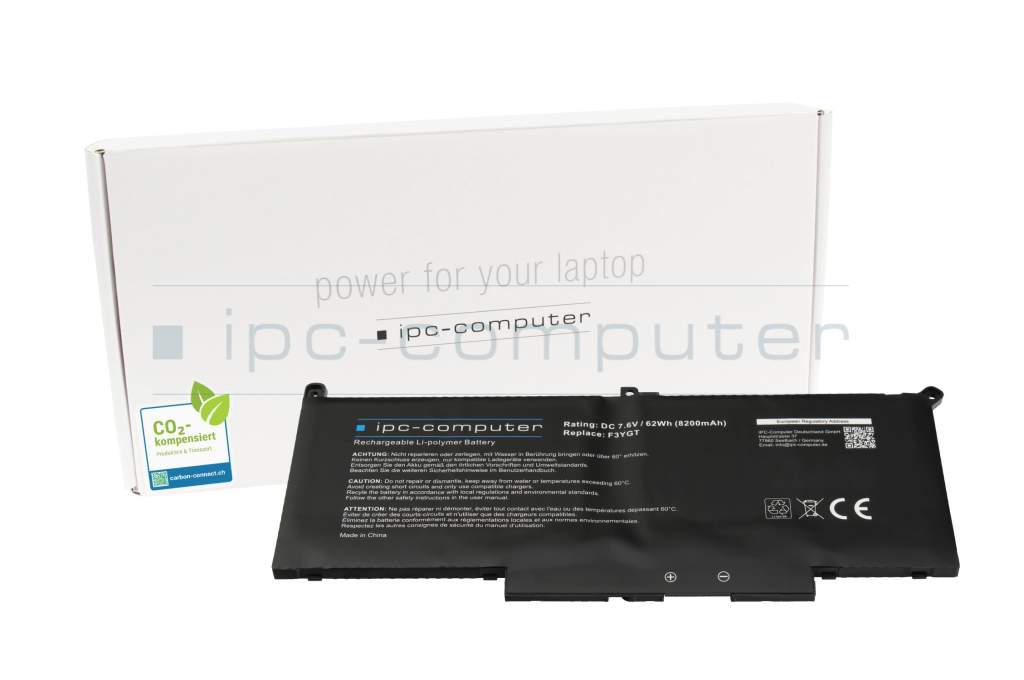
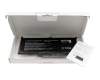
IPC-Computer battery compatible to Dell H2V87 with 62Wh


plus shipping charges
- Standardlieferung 22. September - 24. September
- Expresslieferung 22. September
- bei Bestellung innerhalb 22 hrs 19 min




Installation in our repair shop
Substitute part numbers:
451-BBYE, MYJ96, F3YGT-V99, V4940, 451-BCCI, FWTYJ, 02X39G, 0451-BBYE, 0DWX9J, DWX9J, 0DELL-V4940, DELL-V4940
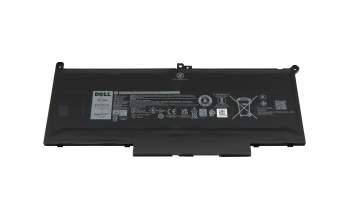
DM3WC original Dell battery 60Wh
plus shipping charges
Product Info
- Manufacturer
- IPC-Computer
- Item Number
- H2V87
- Sub-Partnumbers
- 451-BBYE, MYJ96, F3YGT-V99, V4940, 451-BCCI, FWTYJ, 02X39G, 0451-BBYE, 0DWX9J, DWX9J, 0DELL-V4940, DELL-V4940
- Safety information
- Sicherheits- & Herstellerkontakt-Informationen
Common data
- Condition
- New
- Manufacturer
- Replacement product from IPC-Computer
- Color
- black
Technical Data
- Battery type
- intern
- Battery technology
- Li-Polymer
- Capacity
- 8200 mAh / 62 Wh
- Output (volt)
- 7.6 Volt
- Number of cells
- 4 Cells
Battery Quality
RoHS kompatibel |
 Weitere Informationen Weitere Informationen |
|
ReachG kompatibel und zertifiziert |
Weitere Informationen |
|
ChemG Einhaltung aller Stoffverbote |
Weitere Informationen |
|
Batterie Gesetz erfüllt |
Weitere Informationen |
Qualitätsicherungsprogram gem. ADR 2.2.9.1.7 |
Weitere Informationen |
|
Sicherheitstests gem. UN38.3 |
Weitere Informationen |
|
| Geprüft wurde auf folgende Punkte: Unterdruckprüfung, thermische Prüfung, Schwingprüfung, Schlagschutzprüfung, äußerer Kurzschluss, Aufprall, Überladung, erzwungene Entladung | ||
Flugzeug zugelassen gem. IATA 2.3.5.9 |
Weitere Informationen |
|
| Ab dem 1.1.2013 schreibt die Luftfahrtbehörde IATA, gem. Bestimmung 2.3.5.9 vor, das ungeprüfte LI-ION Akkus vom Transport in Flugzeugen ausgeschlossen sind. Stellt der Hersteller jedoch sicher, das seine Replacement Akkus den Sicherheitstest gem. UN38.3 erfolgreich bestanden haben, sind diese zum Transport im Handgepäck zugelassen. | ||
Vorteile eines IPC-Computer Akkus
Notebook Akkus der Hausmarke IPC-Computer sind Ersatz-Akkus höchster Qualität.
Alle IPC-Computer Akkus enthalten nur die qualitativ hochwertigsten Zellen. Wir lassen diese Akkus in einer der größten Produktionsstätte für Replacement-Akkus in China fertigen. Hier wird vom Platinen-Design, über die Gehäusekonstruktion bis hin zur Produktion und Qualitätssicherung alles aus einer Hand gefertigt. Die sehr niedrigen Ausfallraten unter 1%, haben uns bewogen, diese Replacement-Akkus mit dem Markenzeichen "IPC-Computer" zu versehen. Sie kaufen damit beste Qualität zum günstigen Preis - garantiert!CO2-Kompensation:
Die bei Produktion und Transport unserer IPC-Computer Akkus entstehenden Emissionen gleichen wir vollständig durch zertifizierte Klimaschutzprojekte aus.
Category
- Category
- Batteries
- Usage
- Laptop
- Excerpt of suitable models for P/N H2V87
- Dell Latitude 13 (7390) , Dell Latitude 14 (7480) , Dell Latitude 12 (7280) , Dell Latitude 14 (7490) , Dell Latitude 12 (7290) , Dell Latitude 13 (7380)
You've found this article over a part number. We'll check if it's the correct sparepart for your machine. To do this, please insert the manufacturer and the name of the model in the order comment.
Videos & Contributions

Determine the battery life of the notebook - this is how it works!
Original notebook battery vs. IPC computer quality
The IPC computer compared to an original. Shown here on a Toshiba PA3817U-1BAS
Learn more >
How can I recharge my notebook battery to 100%?
Important and useful informations about laptop Batteries
Frequently asked questions about Batteries
All questions about Batteries
Batteries FAQ
Accessories, suitable alternative products and recommendations
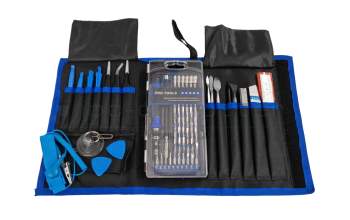
IPC-Computer SCREW2 Screwdriver and opener set - 80 pieces
plus shipping charges